The freight platform market is fragmented and heavily localised, and that fragmentation costs international logistics teams real money. To find loads and trucks, a forwarder often has to keep three or four freight exchanges open at once, re-enter the same data, and monitor responses in parallel. The result is predictable: higher operating costs, slower decisions, and specialists who spend their day copying information between tabs instead of optimising routes. This logistics case study looks at how a single integration between two systems removes that duplication — and what it changes for shippers, carriers and forwarders working between the EU, the CIS and Asia.
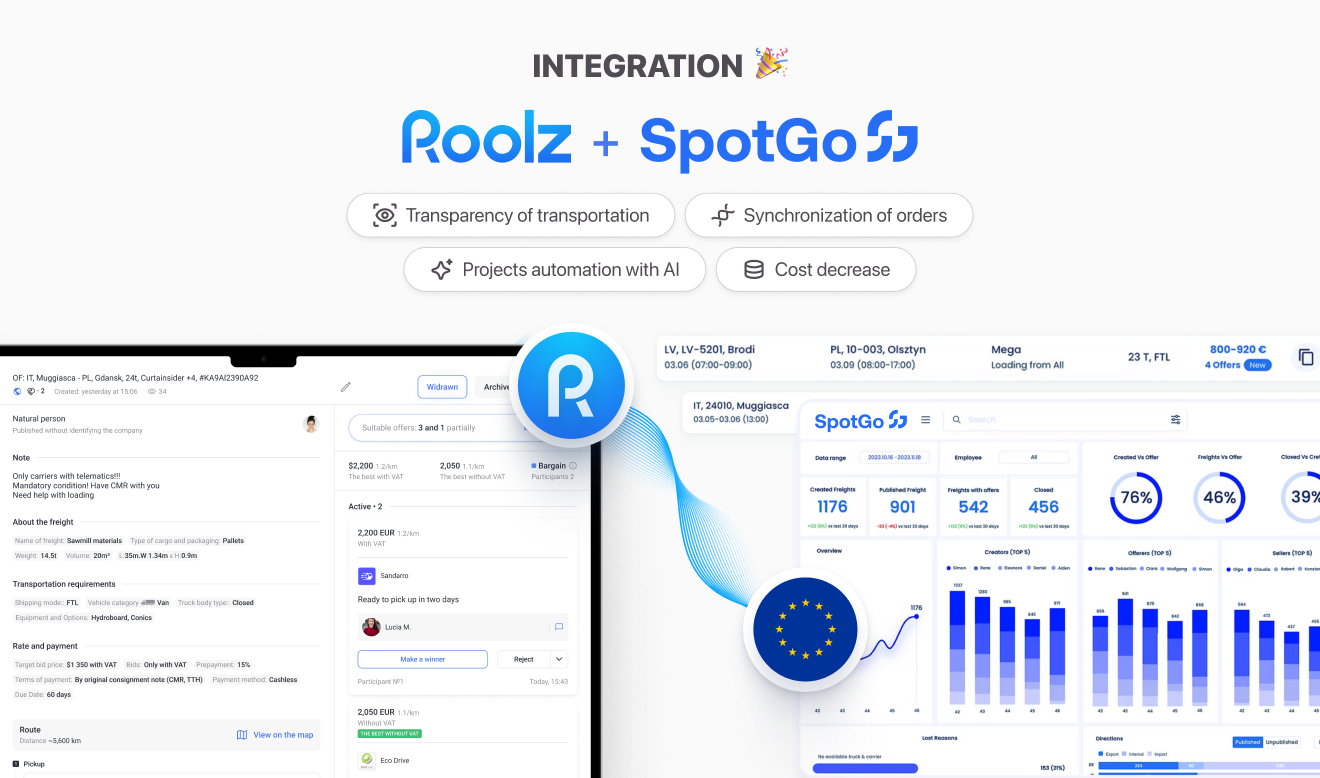
The answer in this case is the integration of Roolz platform and SpotGo. It automates load distribution and brings leading freight tools together in one place. Below we explain how the integration works, what it gives to the logistics managers, forwarders and procurement specialists, and how to set it up step by step.
Эксперты:

Anastasia Dashkevich
Head of Marketing and Communications at Roolz

Daniel Gvozdovich
СЕО at SpotGo
Roolz and SpotGo: what the integration actually does
Roolz is a modern IT system for sourcing, procuring and organising freight transportation. Its core job is to help cargo owners and carriers find each other — whether for a one-off spot shipment or for a long-term partnership on a private exchange. Alongside the marketplace, Roolz works as a TMS layer for managing contractors and customers.
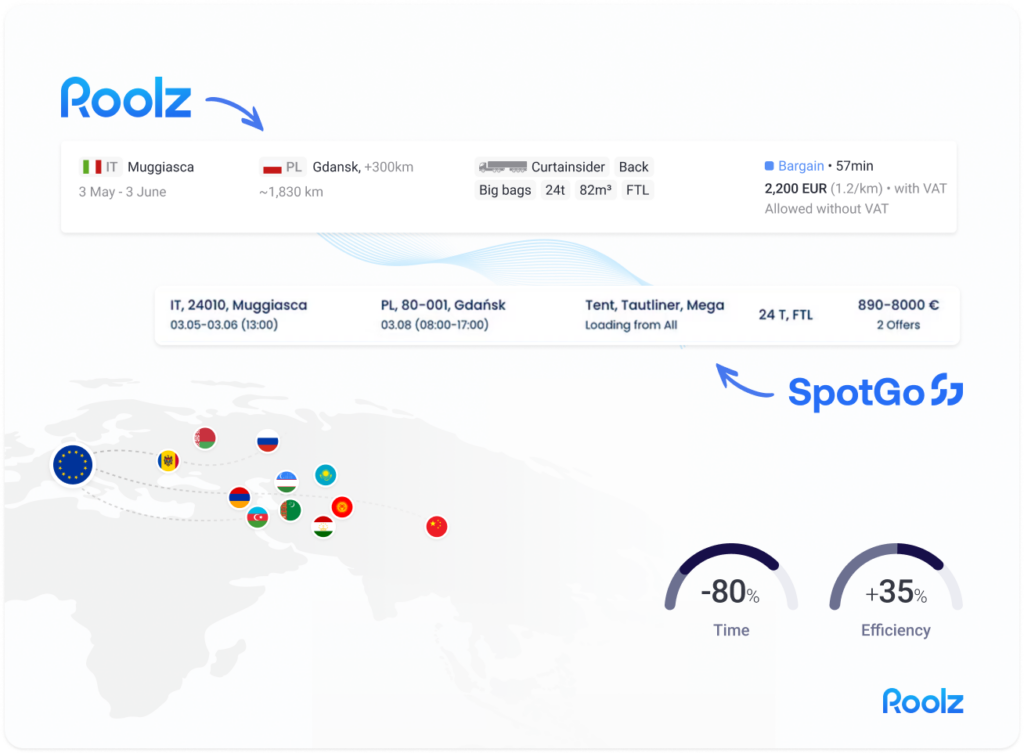
SpotGo is an AI-based freight management system that lets users publish loads to multiple freight exchanges from a single window. Instead of offering the same load separately in every system, a logistics manager inputs it once and SpotGo distributes it.
Together, the two systems deliver a measurable efficiency gain: users report working 30–35% faster and more effectively than with the traditional approach of handling each exchange separately. If you track KPIs in transport logistics, that difference shows up quickly in time-to-cover and manual-touch metrics.
The main goal of the integration is to connect cargo owners with carriers and forwarders from Europe, the CIS, Asia and China. Despite the sheer number of freight platforms on the market, most of them remain local and disconnected from one another — and until now there has been no shared space where they could interact. Roolz–SpotGo connection creates that space.
The need for it became sharper as major European exchanges such as Trans.eu and Timocom restricted the publication of loads to Russia and Belarus. Market participants were left without effective tools for cross-border matching, while demand for freight between the EU and the CIS/Asia stayed high.

Anastasia Dashkevich
Head of Marketing and Communications at Roolz
Logistics problems feed straight into the cost of goods: the higher the transport costs, the higher the price on the shelf. Business will always find a way to move the cargo — the question is at what price.
If we can cut logistics costs, even partially, that’s a win not only for companies but for end consumers too. The more efficient the supply chain, the more affordable the product becomes for every one of us.
Roolz + SpotGo = access to the missing market
The integration of Roolz and SpotGo closes that gap by building one digital space for exchanging freight information between:
- the European Union,
- the CIS countries (Russia, Belarus, Kazakhstan, Uzbekistan and others),
- China and other Asian regions.
To get started, users register on SpotGo and configure the connection to Roolz — after that, all the functions they need are available in one place. On top of that, for SpotGo users the first 2 months of Roolz connection and publishing loads on the public exchange are free.
One interface, the full set of capabilities
Roolz platform users get:
- direct access to requests and offers from both sides, without switching tools;
- automatic data synchronisation between the systems;
- an international partner network instead of a purely local one;
- a realistic path to scaling the logistics business.
What the integration gives each party
For cargo owners and freight forwarders:
- automatic matching of transport by route, price and conditions;
- participation in bidding and cost optimisation;
- instant booking — no intermediaries, no phone calls.
For carriers:
- broader access to orders to and from Europe and Asia;
- transparent rates and immediate confirmation;
- automatic selection of requests matching the fleet’s parameters.
Shared capabilities:
- e-mail notifications about new orders, changes and auctions;
- data export in Excel, CSV and JSON;
- work on the open exchange or on a private exchange for trusted partners;
- a built-in business messenger for direct communication;
- the Roolz company catalogue — a showcase for your services and a tool for finding partners.
Because all shipment documents stay in one space, teams do not need to rebuild context from email threads every time an order changes hands.
Why this matters
Roolz–SpotGo connection is more than a technical bridge. As a system integration example in freight, it is a strategic decision that makes logistics:
- faster — fewer manual operations, quicker transport sourcing;
- cheaper — thanks to bidding and a genuinely competitive environment;
- more reliable — with transparent management of every step;
- more modern — with AI support, API access and multi-platform interaction.
For teams working systematically on cost, the effect compounds: the same tools that speed up matching also help reduce transportation costs by widening the pool of carriers competing for each load.
Daniel Gvozdovich
СЕО at SpotGo
Our industry has been one of the least digitalised: the technology was ageing, there was a shortage of staff, and operational efficiency was falling. Artificial intelligence is one of the solutions that can radically change how we automate routine tasks and modernise legacy systems. Integration and interaction between systems play a key role — users need to be able to work through a single interface and reach all the tools they need from there.
How it works: an API integration example in plain language
Roolz users can now receive offers on SpotGo loads in real time, pick the best conditions and place orders instantly — which shortens sourcing time and streamlines day-to-day work. The only prerequisite is an active account on both SpotGo and Roolz.
💡 Please note! Full access to the integration’s capabilities requires working on Roolz on behalf of a company.
We’ll assume you’re already registered on Roolz, acting on behalf of a company as an administrator or owner, and that you have a SpotGo account.
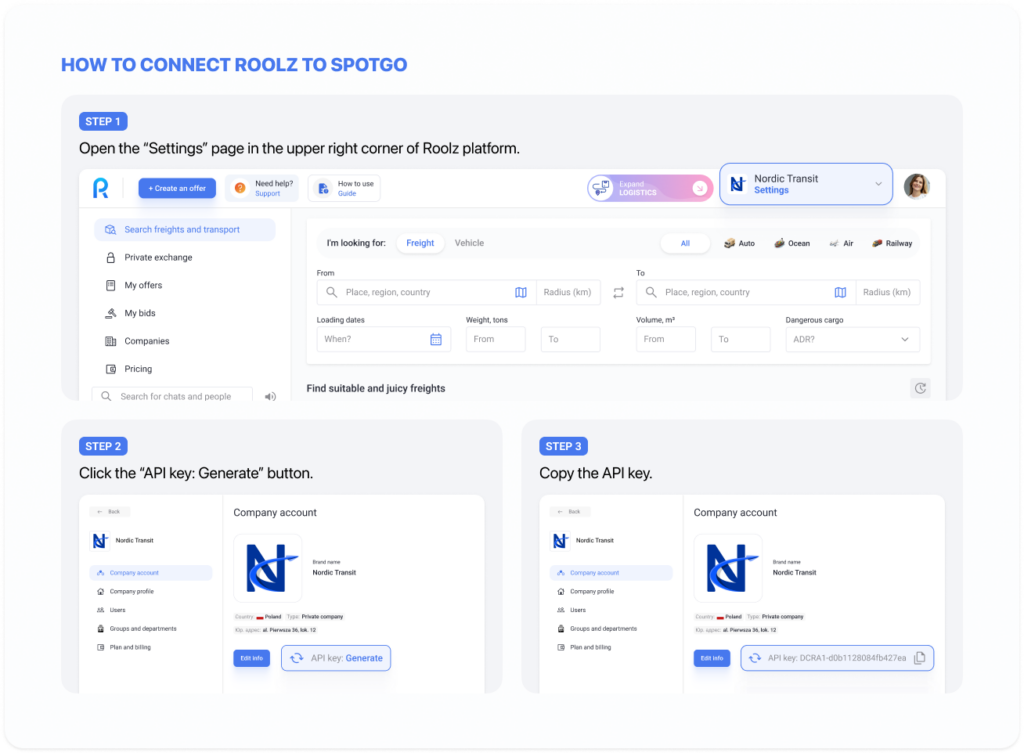
To activate and configure the connection, open Roolz platform and follow these steps:
1️⃣ Open the Management section in the top right corner of the platform.
2️⃣ In the Company account window that appears, click API key: Generate.
3️⃣ Copy your company’s API key — you’ll need it to set up the connection on SpotGo platform.
💡 Please note! The e-mail address used to register on Roolz must match the one specified in SpotGo, and vice versa.
Next, configure the integration on the SpotGo side. This part is a straightforward example of how to integrate via API without any development work on your side:
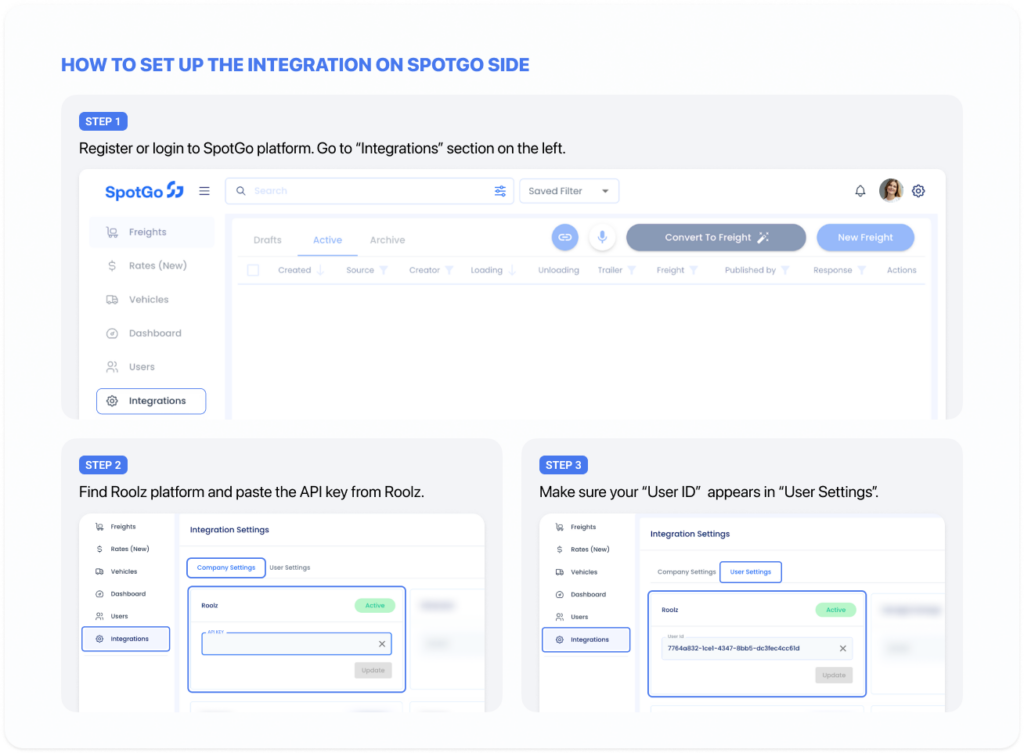
1️⃣ Register or log in to SpotGo. After signing in, you’ll land on the main page.
2️⃣ Go to the Integrations section, which lists the freight exchanges already integrated with SpotGo.
3️⃣ In Company Settings, find Roolz platform.
- Paste the key you copied from Roolz into the API KEY field.
- Click Update to save the settings.
4️⃣ Open User Settings and find Roolz again.
5️⃣ Make sure your User ID appears in the Roolz field. If the field is empty, contact Roolz support — the team will help you resolve it.
Congratulations — the integration is up and running 🎉 From now on you’ll get more responses to your offers and can choose the best options for your company.
Where this API integration example pays off first
The technical part takes minutes, but the practical value shows up in specific scenarios: when a load has to be covered on short notice and the local carrier pool isn’t enough; when the same offer needs to reach both EU and CIS markets at once; when procurement wants competitive bids rather than a single quote; and when a forwarder handles multimodal shipments and needs one place to keep requests, files and communication together. In all of these cases, platform integration removes the duplicate posting work that used to eat the first hour of every morning.
Ready to connect?
If you already use SpotGo or Roolz, setting up the integration takes a couple of minutes. And you’ll feel the difference in speed, convenience and results from day one.
📌 Important: the integration is available to companies only. Make sure you’re registered as a legal entity.
Digital logistics is already here. Connecting two systems won’t rebuild your supply chain overnight — but it will give your team back the hours it currently spends re-typing the same load into four different exchanges.